Materials · Manufacturing · FEA
Lightweight Bicycle Frame Study
A materials and structural engineering study developing a lightweight hardtail mountain-bike frame through material screening, manufacturing analysis, analytical calculations, fatigue assessment and SolidWorks finite-element analysis.
The study focused on a premium all-metal hardtail frame designed for riders up to 100 kg, with a frame-mass constraint below 5 kg.
View Technical Report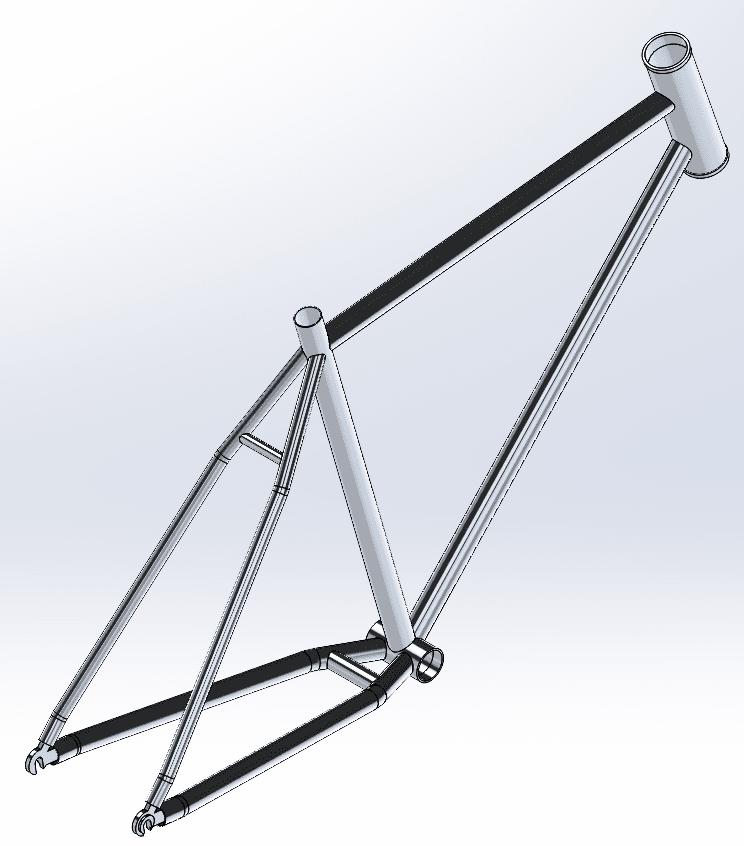
Design Brief
The design challenge was to develop a high-end hardtail mountain-bike frame that remained lightweight while providing sufficient strength, fatigue resistance, corrosion resistance and manufacturability for repeated off-road use.
- Frame mass
- < 5 kg
- Rider mass
- Up to 100 kg
- Application
- Hardtail mountain bike
- Environment
- Wet / muddy outdoor use
- Material class
- Metals only
- Design priority
- Premium durability and performance
Representative loading conditions
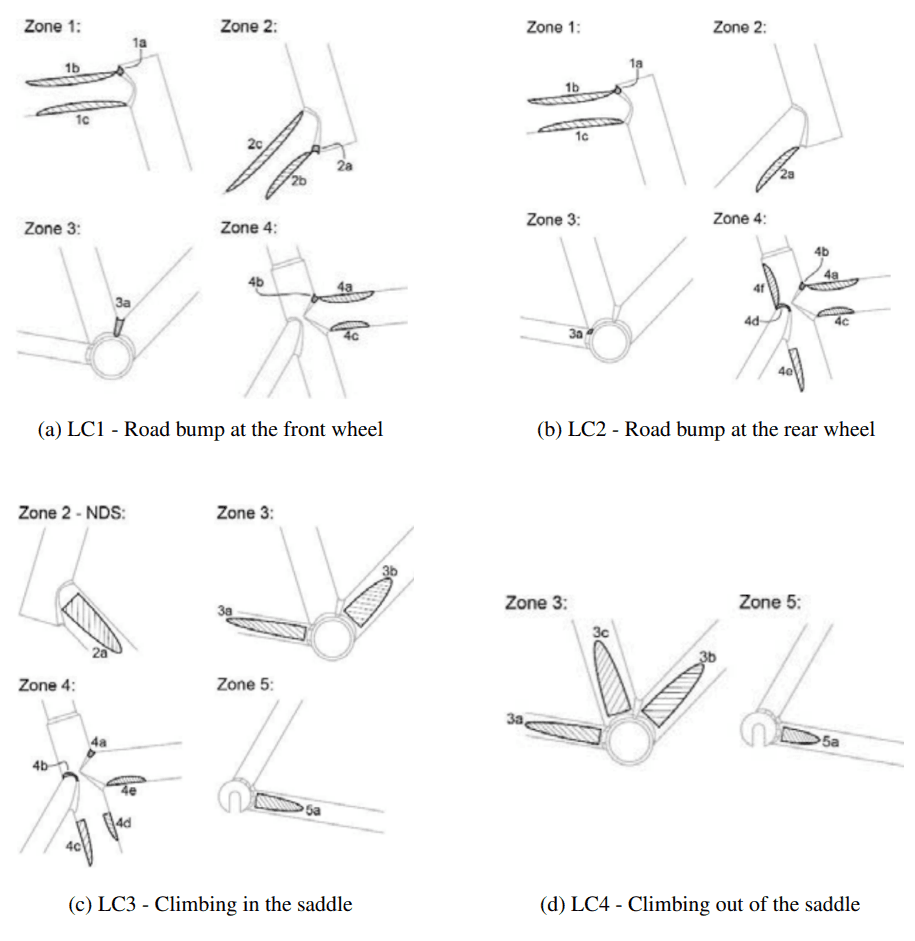
The loading study considered how repeated road and trail inputs can concentrate demand around the frame's principal welded junctions.
- LC1 — Front-wheel road bump
- Impact loading introduced through the front wheel, increasing structural demand around the front of the frame and adjoining welded joints.
- LC2 — Rear-wheel road bump
- Rear-wheel impact loading representing repeated trail or road inputs transmitted through the rear frame structure.
- LC3 — Climbing in the saddle
- A seated climbing condition representing combined rider and pedalling loads acting through the frame.
- LC4 — Climbing out of the saddle
- A higher-demand climbing condition representing more pronounced rider and pedalling forces through the frame structure.
Material Selection
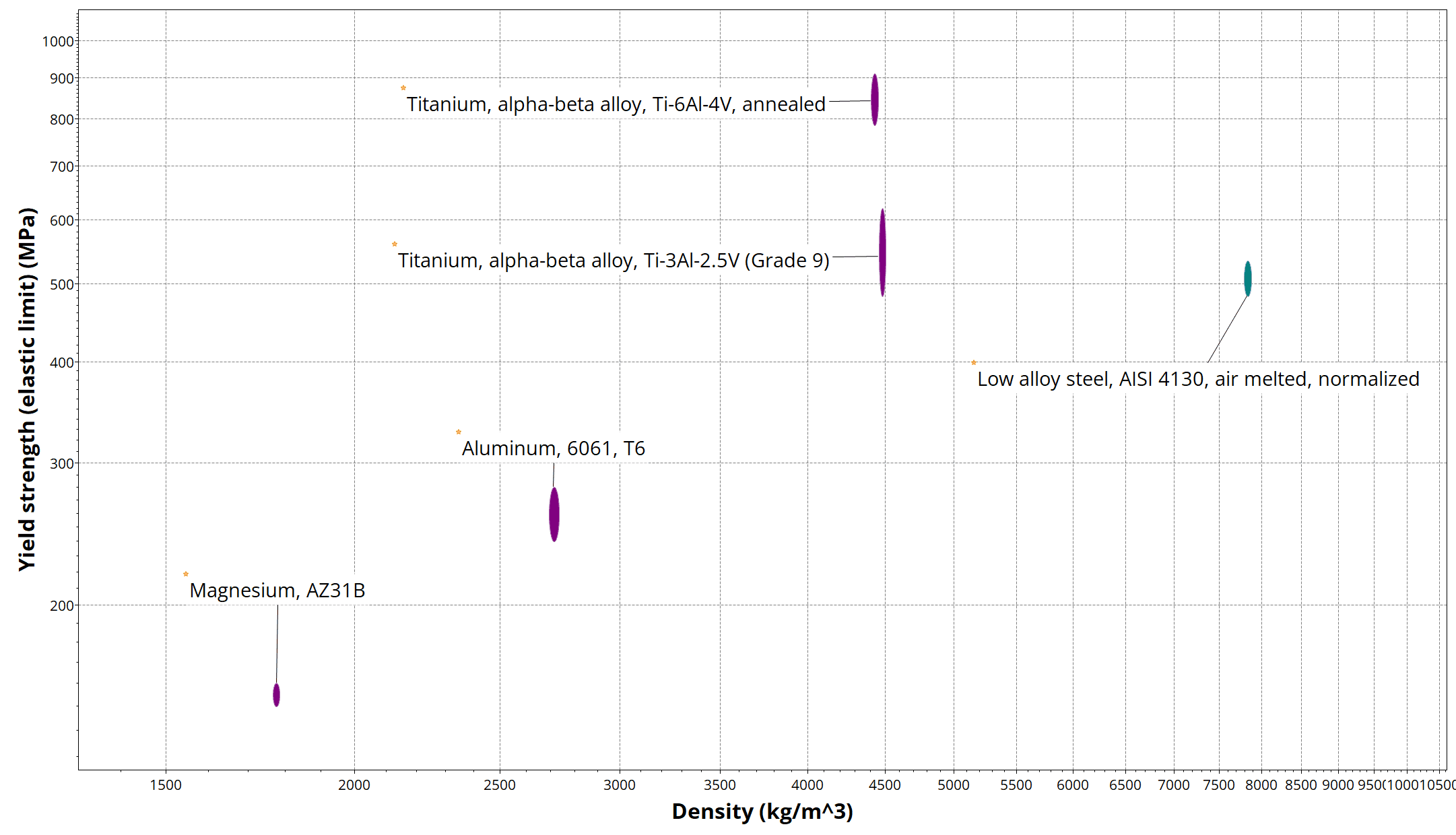
The material selection stage compared five metallic candidates using specific stiffness, specific strength, fatigue resistance, corrosion resistance, weldability, manufacturability and lifecycle durability.
Ti-3Al-2.5V
Grade 9 titanium
Ti-6Al-4V
Annealed titanium
AISI 4130
Normalised steel
6061-T6
Aluminium
AZ31B
Magnesium
Material screening process
The screening process progressively narrowed the candidate materials from basic density, stiffness and strength requirements through fatigue, corrosion, off-road durability and manufacturing suitability.
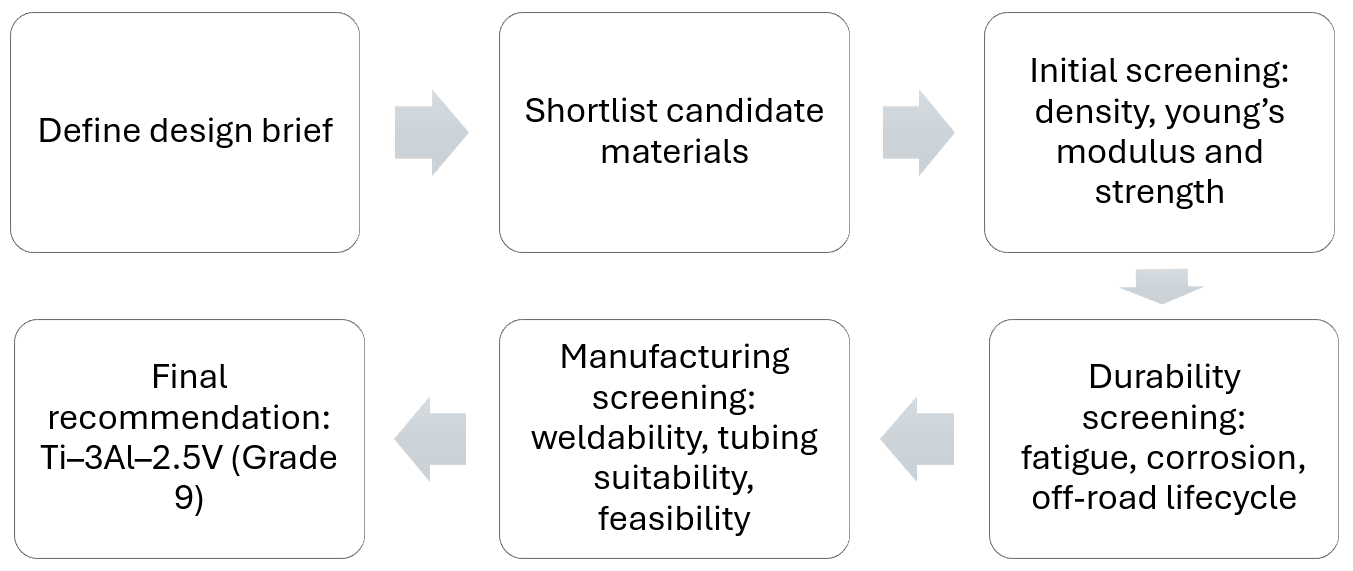
- 01Design requirements
- 02Material shortlist
- 03Mechanical screening
- 04Durability screening
- 05Manufacturing screening
- 06Final selection
Selected Material
Ti-3Al-2.5V — Grade 9 Titanium
Ti-3Al-2.5V achieved the strongest overall balance of specific strength, fatigue resistance, corrosion resistance and compatibility with welded tubular construction.
- Weighted decision score
- 4.20 / 5
Fatigue performance was particularly important because repeated off-road loading and welded-joint durability were treated as primary design constraints rather than secondary considerations.
Manufacturing Strategy
The selected concept used butted Ti-3Al-2.5V tubing and a conventional welded diamond-frame architecture. The proposed manufacturing route prioritised accurate tube preparation, controlled welding and alignment.
- 01Butted tube selection
- 02Cutting
- 03Precision mitring
- 04Local forming
- 05Fixturing
- 06Inert-gas welding
- 07Alignment & inspection
- 08Finishing
Weld quality is a critical part of the titanium manufacturing strategy because contamination, heat input and joint preparation can strongly affect fatigue performance.
CAD Development
The CAD model used a traditional hardtail diamond-frame configuration compatible with welded tubular construction. The geometry provided the basis for mass calculation and full-frame structural analysis.
Predicted bare frame mass
1.19 kg76% below the 5 kg design limitPredicted from CAD-model volume and Ti-3Al-2.5V density; not a measured manufactured-frame mass.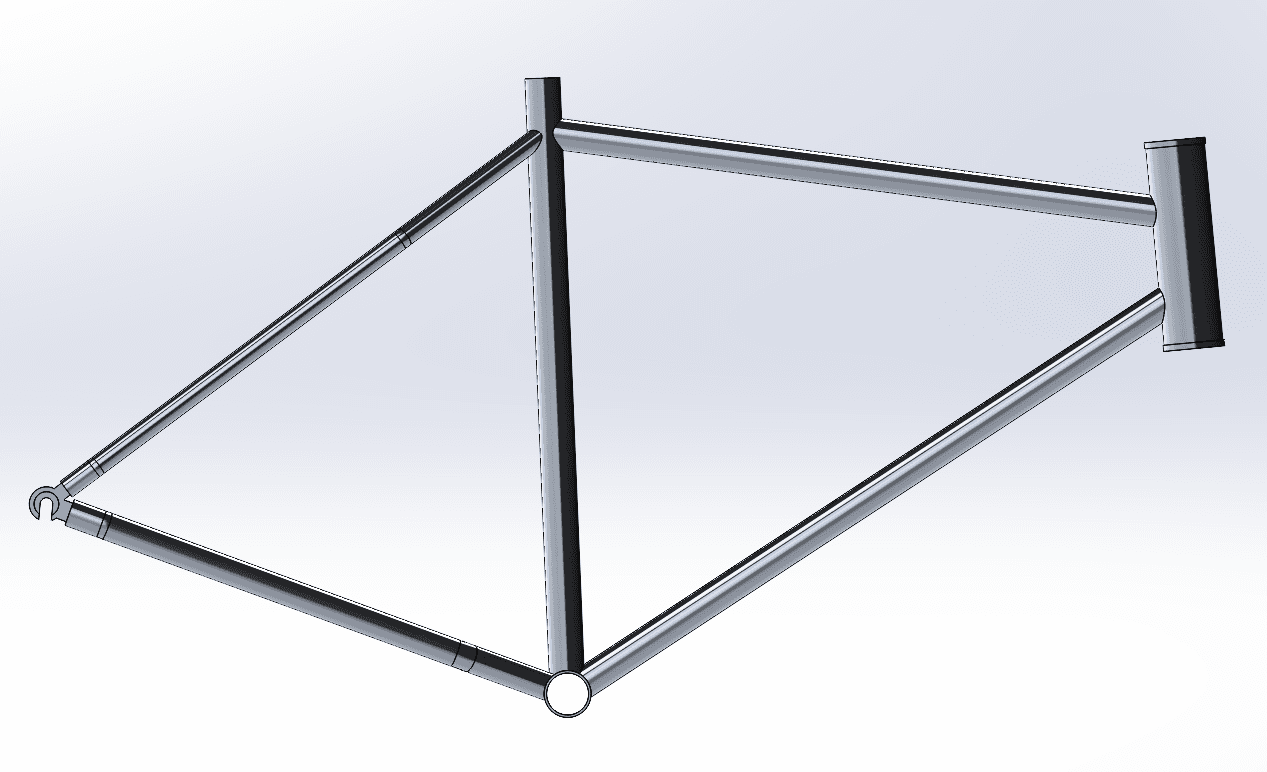
Structural Analysis
Before full-frame FEA, a simplified beam model was used as a conservative first-principles check of the down tube under the nominal rider load.
- Design load
- 981 N
- Maximum combined stress
- 238.6 MPa
- Static safety factor
- 2.31
The beam model is intentionally conservative because the real welded frame distributes load through multiple structural members.
Simplified Beam Model
- Nominal design load
- 981 NSafety factor: 2.31
- ISO vertical fatigue load
- 1500 NSafety factor: 1.55
- ISO combined strength load
- 2200 NSafety factor: 1.06
Fatigue Assessment
Because the frame is intended for repeated off-road use, fatigue performance was assessed using a Modified Goodman approach rather than relying only on static strength.
Under the assumptions used in the concept-level model, the assessment satisfied the Modified Goodman criterion. The model indicated an infinite-life condition beyond 10⁷ cycles under the assumed normal service loading.
Goodman fatigue safety factor
1.87Concept-level analytical prediction; weld-toe effects, local defects and heat-affected-zone behaviour are not fully represented.Finite Element Analysis
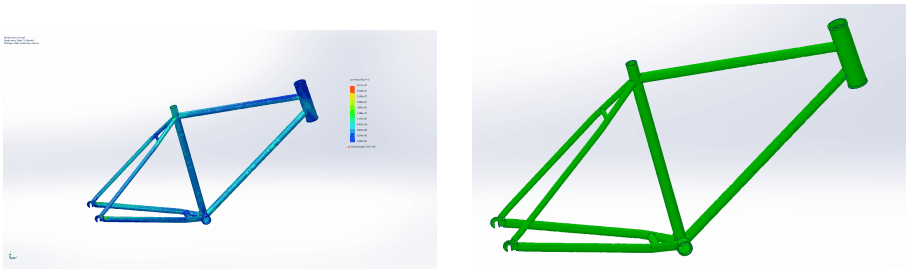
A static structural study was completed in SolidWorks Simulation using the full bicycle-frame geometry and custom Ti-3Al-2.5V material properties. Two simulated load cases were examined: a 981 N nominal design load and a 1962 N doubled qualification load.
FEA Results
- 981 N minimum safety factor
- ≥ 4.0
- 981 N maximum displacement
- 0.122 mm
- 1962 N minimum safety factor
- ≥ 2.0
- 1962 N maximum displacement
- 0.2441 mm
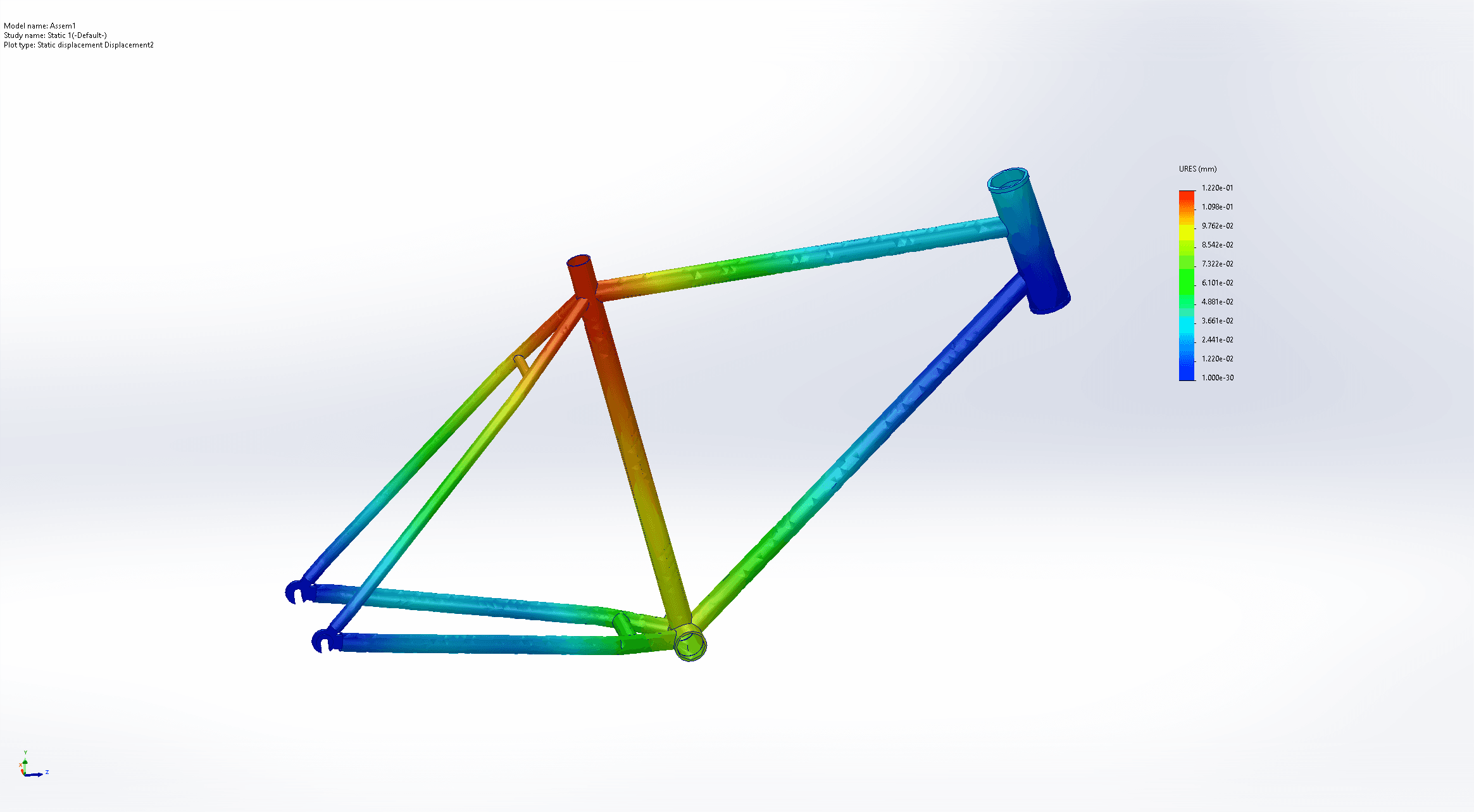
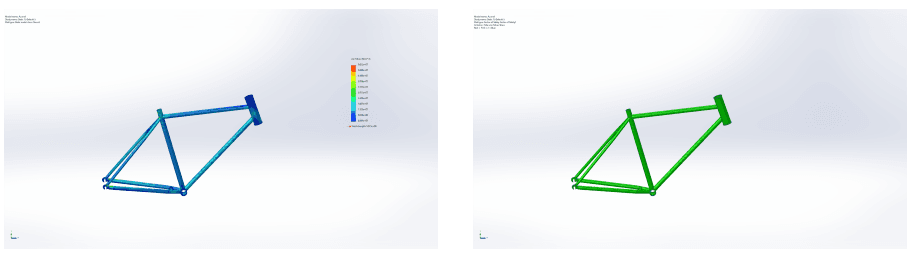
The displacement approximately doubled when the applied load doubled, which was consistent with linear-elastic behaviour in the simulation.
Critical Regions
- Bottom bracket / down-tube junction
- Head-tube region
The highest stresses were concentrated around major structural junctions rather than along the lower-stress tube spans. This supported tube butting and local reinforcement around highly loaded regions.
Analytical vs FEA
- Analytical model
- Conservative single-member approximation
- Full-frame FEA
- Captures load sharing across the welded frame
The simplified beam model produced lower safety factors because it concentrated the design load into one representative structural member, whereas the full-frame FEA distributed the load through the complete frame geometry.
Engineering Outcome
The study identified Ti-3Al-2.5V as the strongest overall material choice for the proposed premium hardtail frame because it linked low mass, fatigue durability, corrosion resistance and welded-tube manufacturability.
The resulting CAD concept achieved a predicted bare mass of 1.19 kg, while analytical fatigue assessment and full-frame FEA indicated structurally credible performance under the investigated loading conditions. This remains a concept study rather than a fully validated production frame.
- Selected material
- Ti-3Al-2.5V
- Predicted mass
- 1.19 kg
- Weighted score
- 4.20 / 5
- Goodman safety factor
- 1.87
- FEA safety factor
- ≥ 4.0 at 981 N
- Double-load FEA
- ≥ 2.0 at 1962 N
Limitations
The study remains a concept-level engineering evaluation. The main uncertainty lies in the welded regions, where local geometry, heat-affected zones, weld quality and manufacturing defects may govern real fatigue behaviour.
Further Development
- Fatigue-specific FEA using welded-joint S-N data
- ISO 4210 physical bench testing
- Strain-gauge measurement at critical frame nodes
- Improved weld-joint modelling
- Tighter weld-shielding and inspection control
Future validation should focus more heavily on welded-joint fatigue behaviour rather than repeating additional static analysis.